
Back on the Table: U.S. Legalization and the Unauthorized Immigrant Groups that Could Factor in the Debate

After several years on the policy sidelines, the debate over legalizing the unauthorized immigrant population was revived with President Joe Biden’s Inauguration Day pledge to send Congress a measure to grant legal status to the nation’s estimated 11 million unauthorized immigrants. Given the failure of broad legalization efforts in 2006, 2007, and 2013, some on Capitol Hill are focusing on tackling the challenge in piecemeal fashion.
Estimates for Different Legalization Bills
A number of legalization bills for different unauthorized immigrant subgroups have been introduced in Congress. MPI has modeled a few of them, including the American Dream and Promise Act and the DREAM Act of 2021.
Get estimates for the DREAMers, TPS or DED-eligible, and Legal DREAMers who could gain legal permanent residence under the American Dream and Promise Act here.
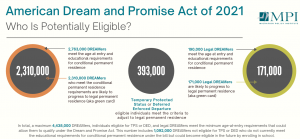
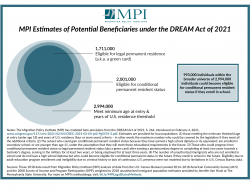
For MPI estimates of the DREAMers who could potentially gain legal status under the DREAM Act of 2021, check out this infographic.
Drawing on MPI’s unique methodology to estimate the size and characteristics of the unauthorized population, this report offers numbers for unauthorized immigrant subgroups that have particularly strong equities, including DREAMers, Temporary Protected Status (TPS) recipients, and parents and spouses of U.S. citizens or permanent residents. It also takes stock of the populations that have provided essential services during the COVID-19 pandemic and faced outsized vulnerability to the disease: Workers in industries deemed essential ones, as well as farmworkers.
The report traces past legalizations and details the range and scope of legalization options that policymakers have, ranging from placing people on a pathway to citizenship, to limited and renewable legal status, or legal protections provided via executive action.
The inability to resolve the status of unauthorized immigrants over more than two decades has thwarted any prospects for broader reform of a U.S. immigration system that urgently requires updating. Amid this stasis, Congress has mounted new obstacles that make it more difficult for those who would otherwise have been eligible to legalize to do so, including the three- and ten-year bars on re-entry to the United States.
The report is part of MPI’s Rethinking U.S. Immigration Policy Initiative, launched in 2019. The initiative is generating a big-picture, evidence-driven vision for the role immigration can and should play in America’s future.
1 Introduction
2 The Unauthorized Immigrant Population: A Profile
Unauthorized Immigrant Subgroups
3 Policy Options: Legislative Reform and Executive Action
A. Legislative Solutions
B. Executive Action
4 Conclusion


