
Barriers to COVID-19 Testing and Treatment: Immigrants without Health Coverage in the United States

From mid-March 2020 through the start of May, as COVID-19 spread across the United States, more than 33 million U.S. workers lost their jobs, with unemployment rising faster among immigrants than the U.S. born. Rapid job loss is leading to steep declines in employer-provided health insurance coverage, which in turn has increased reliance on publicly funded health care for screening and treatment for the virus. Yet many immigrants who have not become U.S. citizens do not qualify for Medicaid, the main public health insurance program for low-income people, because of eligibility restrictions related to immigration status.
The undetected and unchecked spread of the virus among any segment of the U.S. population—whether U.S. or foreign born—risks driving further transmission, with severe consequences for communities across the country. And with many immigrants working in frontline industries such as health care and food production, barriers that keep them from accessing and affording timely care place additional strain on U.S. health systems and the food supply.
U.S. and State Data
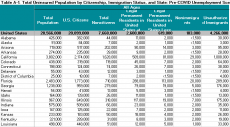
This spreadsheet has estimates of the total uninsured and the low-income uninsured populations for the United States, each state, and the District of Columbia, broken down by citizenship and immigration status and for children ages 0 to 18. Click here.
This fact sheet provides national and state-level estimates of the number of uninsured noncitizens (legal permanent residents, or LPRs; nonimmigrants such as students and temporary workers; and unauthorized immigrants). Because employer-provided insurance coverage is likely to decline as unemployment rises, estimates are given for three different unemployment scenarios:
- In a pre-COVID-19 scenario of 4 percent unemployment, 7.7 million noncitizens did not have public or private health insurance coverage.
- In a medium-unemployment scenario of 17.5 percent unemployment, 9.3 million noncitizens would be uninsured.
- In a high-unemployment scenario of 25 percent unemployment, 10.8 million noncitizens would be uninsured.
The fact sheet also provides estimates of how many low-income noncitizens could potentially be covered by Medicaid but are ineligible due to their immigration status—ranging from 2.6 million pre-COVID-19 to 3.7 million in the high-unemployment scenario.
1 Introduction
2 The Policy Context
3 Uninsured U.S. Citizens and Noncitizens under Different Unemployment Scenarios
4 Uninsured U.S. Citizens and Noncitizens Potentially Eligible for Medicaid or Similar Public Coverage
5 Uninsured Noncitizen Populations by State
6 Conclusions

