


What Does Integration Mean in a Multicultural Country like Canada?

A new Canadian citizen greets a Royal Canadian Mounted Police officer at a citizenship ceremony in Ontario. (Photo: stacey_newman/iStock.com)
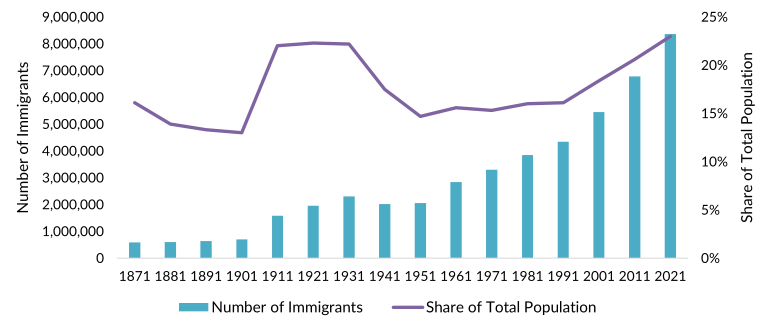
Canada’s immigrant population has always been relatively sizable and is now growing by leaps and bounds. Its nearly 8.4 million immigrants as of 2021 comprised one of the ten largest foreign-born populations globally and represented 23 percent of Canada’s total population. Immigration is the leading source of population growth, following the decline of fertility rates amongst the Canadian born, and new policies to increase arrivals mean that by 2041, as much as 34 percent of the country could be foreign born, and more than half the population may be either immigrants or their Canadian-born children. Already, roughly half of the residents of metro Toronto were foreign born as of 2021, according to the authors’ calculations, and roughly 4 percent were non-permanent residents. Rising immigration may have sparked a recent backlash, with many Canadians fearing that new arrivals are contributing to the high cost of housing and other goods. As the government increases permanent immigration, it is also looking to cap the number of temporary residents.
This dynamic complicates longstanding understandings of the relationship between established communities and newcomers. Approximately 40 years ago, sociologist Doug Massey argued that immigrants and other minority groups who integrated into the residential “mainstream” could gain tangible benefits such as improvements in health, education, employment opportunities, and social prestige. This “spatial assimilation” process of moving into and then out of initial reception communities known as ethnic enclaves was described as a model of status attainment. Immigrants initially clustered together because of discrimination, few employment opportunities, a common language, or other factors, the thinking went, but should eventually merge into the mainstream by moving to a typically less segregated neighborhood, at which point they would be assimilated or integrated in their new society.
Yet as Canada’s increasing diversity shows, this idea has lost its luster. Not only are Canada’s immigrants growing in numbers, they are also increasing in origins. While metro Toronto is now roughly evenly split between immigrants and the native born, no single immigrant group represented more than 15 percent of the entire metro area population in 2021, with the largest being individuals from India (14 percent) and China (10 percent), both themselves countries of vast diversity in their own right. Although most diversity in national origins is in Canada’s urban centers, change is also afoot in rural parts of the country, and likely to accelerate if the government continues with policies designed to drive immigrants to rural areas. Add in the country’s split between an Anglophone majority and a Francophone minority centered in Quebec, which is home to about 22 percent of the population (and 15 percent of immigrants), and the dynamic becomes even more complicated.
This situation poses new questions about the meaning of words such as integration. What, for example, does it mean to fit in when there is no clear single group in which to fit?
This article examines Canada as an example of a country where increasing immigration and diversity have complicated the traditional understandings of integration. The country’s already diverse immigrant flows have become increasingly superdiverse and underscore the declining importance of a core mainstream group into which new arrivals are expected to integrate.
Immigration trends have shifted across time in Canada due, in large part, to changes in policy, although the foreign born have always comprised at least one-eighth of the population (see Figure 1). Before 1934, immigration policy placed an emphasis on newcomers in highly skilled sectors, which, combined with restrictions including the Chinese Exclusion Act, resulted in most individuals arriving from Europe and the United Kingdom. In 1901, 13 percent of the population was foreign born, a historical low. Between 1946 and 1974, laws somewhat expanded the pool of eligible newcomers, but true shifts in inclusivity occurred post-1970 and into the 2000s. This is especially evident when looking at the 2013-18 period, during which Asia (including the Middle East) became the largest source of new arrivals, followed by Europe and other locations. There were people of more than 200 ethnic origins living in Canada in 2011, with 13 of these groups surpassing 1 million members, and more than 6 million people identifying as visible minorities, whom the government defines as neither White nor Indigenous. The number of immigrants arriving in 2000-01 (253,000) nearly doubled by 2022-23 (469,000), although emigration similarly increased from nearly 48,000 people in the 2000-01 period to 95,000 in 2022-23. While these numbers fluctuate across time, there are mostly relatively steady rates of both entrances and exits.
Figure 1. Number and Share of Immigrants in Canada, 1871-2021
Sources: Statistics Canada, “150 Years of Immigration in Canada,” updated May 17, 2018, available online; Statistics Canada, “Immigrants Make Up the Largest Share of the Population in Over 150 Years and Continue to Shape Who We Are as Canadians,” updated October 26, 2022, available online.
Once in Canada, the general trend is for immigrants to settle in large urban areas, especially the three main gateway cities: Toronto, Vancouver, and Montreal. In fact, while one in four residents in urban Canada was foreign born as of 2019, their share was just one in 20 for more rural regions. There are multiple reasons for the evident preference for cities, including perceptions that urban areas offer stronger economic conditions, greater job opportunities, and more expansive co-ethnic and social networks. Yet the trend is gradually shifting. Approximately 90 percent of all new arrivals between 1996 and 2001 opted for the provinces of Ontario or British Columbia, declining to 71 percent between 2011 and 2016. Similarly, the share of immigrants living in the three largest cities decreased from 73 percent of the overall foreign-born population in 2011 to 56 percent five years later.
Recent and Future Arrivals
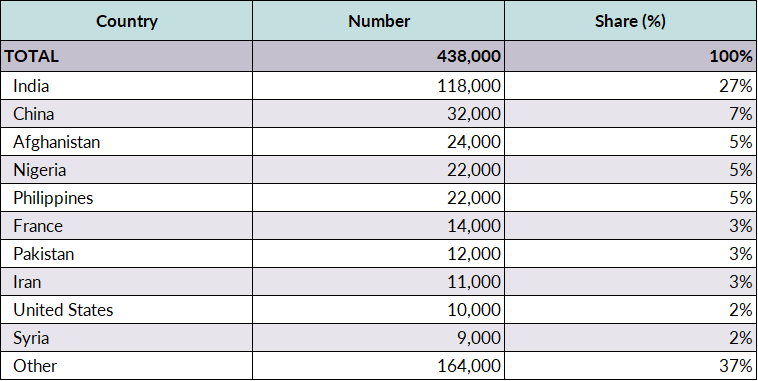
In terms of more recent patterns, nearly 438,000 individuals arrived as permanent residents in 2022, the most recent year for which data are available, of whom 256,000 entered as economic immigrants; 97,000 as family-sponsored immigrants; 74,000 as refugees and protected persons; and 10,000 through humanitarian, compassionate, and public policy grounds (more discussion of these categories below). For the fourth consecutive year, Canada was the world’s top refugee resettlement country, although the United States returned to its traditional position as top resettlement destination in 2023. India was the top origin country of immigrants arriving in 2022, accounting for 27 percent of all arrivals that year, followed by China (7 percent; see Table 1).
Table 1. New Permanent Residents Admitted to Canada, by Country of Origin, 2022
Source: Immigration, Refugees, and Citizenship Canada (IRCC), 2023 Annual Report to Parliament of Immigration (Ottawa: IRCC, 2023). available online.
The government intends to keep the number of arrivals of permanent immigrants high, even as it seeks to reduce the number of temporary immigrants. Canada’s Immigration Levels Plan for 2024-2026 aims to admit nearly 1.5 million new permanent residents over the three-year period, including 281,000 economic immigrants in 2024 and 301,000 annually in 2025 and 2026, as well as 114,000 family-based immigrants in 2024 and 118,000 in each of 2025 and 2026. The number of incoming refugees and protected persons, on the other hand, is set to decrease slightly from 76,000 in 2024 to 73,000 in 2025 and 2026. A similar decrease is predicted for admissions under the humanitarian and compassionate grounds category, from 14,000 in 2024 to 8,000 in 2025 and 2026. Meanwhile the government aims to cap temporary immigration, including international student admissions, dropping temporary residents’ 6.2 percent share of Canada’s population to 5 percent over the next three years.
Main Immigration Categories and Key Recent Policy Changes
Canada’s immigration system is divided into several key categories targeting various immigrant groups: the economic class, the family class, refugees and asylum seekers, humanitarian and compassionate grounds, and temporary residence. Even before the post-pandemic changes to increase permanent immigration, policy had been changing drastically, reflecting the country’s evolving priorities, economic needs, and humanitarian commitments, and pushing it towards a future where immigrants account for a growing share of the population.
Economic and Family Class
The economic class is the largest category, and arrivals through this route may be less likely to settle in segregated ethnic enclaves than those arriving through family reunification pathways, as is more common in places such as the United States. This channel is designed to attract workers with the education, experience, and skills to fill labor market shortages. It includes the Express Entry System, which is an online application management system for the Federal Skilled Worker Program targeting foreign-born workers who meet criteria in areas such as education, language proficiency, and work experience; the Federal Skilled Trades Program, aimed at skilled tradespeople; and the Canadian Experience Class, for individuals with at least one year of skilled work experience in Canada. The Express Entry system was launched on January 1, 2015, after being established under amendments to the Immigration and Refugee Protection Act. It uses a points-based system to assess and rank applicants based on factors such as age, education, work experience, and language proficiency. This system replaced the previous first-come, first-served approach of skilled worker programs with a more dynamic model, making the application process more efficient and competitive, allowing Canada to better manage applications based on current labor market needs. Principal applicants under the new system generally outperform immigrants arriving through other channels, according to a 2020 evaluation from Immigration, Refugees, and Citizenship Canada (IRCC).
Another major economic immigration stream is the Provincial Nominee Program, which incorporates the specific needs of provinces and territories by allowing them to nominate individuals who wish to settle there. Through this program, provinces and territories can recruit immigrants to address specific labor market needs, encouraging the distribution of immigrants across the country and promoting balanced economic development.
The family class immigration category allows Canadian citizens and permanent residents to sponsor close family members, including their spouse, parents, grandparents, and children. This category promotes family unity and social stability.
Refugee and Protection Systems
Canada’s refugee and asylum program underscores its commitment to humanitarian efforts and international responsibilities. Refugees typically seek protection outside their origin country before applying to enter Canada, while asylum seekers are physically present in Canada and claim protection at a port of entry or an inland office. Canada’s unique system for refugee resettlement includes not just the Government-Assisted Refugees program involving individuals selected and whose travel is funded by the Canadian government, which also provides financial support and services for up to one year after arrival, but also privately sponsored refugees who are identified by private groups or organizations that also provide financial support. A third option, known as the Blended Visa Office-Referred Program, combines government and private sponsorship; refugees are referred by the UN High Commissioner for Refugees (UNHCR) and matched with private sponsors who share financial support with the government.
Modifications in 2012 provided clearer processes for refugees, enhanced access to appeal of asylum denials, and sought to ensure that vulnerable individuals receive timely protection and support. The changes were introduced through the Protecting Canada’s Immigration System Act and the Balanced Refugee Reform Act, which together created the Refugee Appeal Division. The legislation also introduced designated countries of origin from which asylum applicants received sped-up processing to deter unfounded protection claims (this program ended in 2019) and created a new risk assessment process to ensure deportees are not removed to countries where they would be unsafe.
Humanitarian and compassionate-grounds applications are for individuals who would not normally be eligible to become permanent residents of Canada, but who have compelling reasons for seeking an exception. Considered factors may include being established in Canada, having family ties in the country, children’s best interests, and the potential hardship of leaving.
Temporary Residents
Finally, temporary residents come to Canada for specific purposes such as to work, study, or for tourism. The Temporary Foreign Worker Program allows Canadian employers to hire foreign workers to fill temporary jobs when qualified Canadians or permanent residents are not available, and the International Mobility Program facilitates the entry of workers who contribute to Canada’s economic and cultural exchange, promoting international cooperation. A study permit allows foreign nationals to enroll at designated learning institutions. International students can work part-time during their studies and may be eligible for a work permit after graduation.
In 2014, the Temporary Foreign Worker Program was restructured and rebranded to clearly distinguish between it and the newly formed International Mobility Program. These changes, implemented through a combination of changes by Employment and Social Development Canada, introduced stricter requirements to ensure that hiring foreign temporary workers did not negatively impact native-born workers. The International Mobility Program, on the other hand, facilitated the entry of temporary foreign workers whose hiring did not require an assessment of the labor market. These changes reduced reliance on low-wage foreign workers and promoted the entry of highly skilled professionals. To further limit temporary residents amid rising public discontent over housing availability and provision of services, this year the government said it intends to cap temporary immigration of students and workers.
Canada has long had an uneasy relationship with conventional notions of assimilation and integration. Despite restrictive periods in its history, the notion that people must change who they are to fit into a new society (“assimilation”) has been increasingly anathema to the country’s multicultural identity. This is especially true as Canada has become increasingly diverse through sustained immigration from a wide array of countries, and the growing dispersal of immigrants to rural areas. Previously, the narrowly defined theory of integration as newcomers becoming indistinguishable from the mainstream seemingly proliferated. At one time, small ethnic enclaves were dotted across Canadian cities, each serving as a welcoming center for new arrivals. Over time, many of these neighborhoods became more appealing for tourists than newcomers. Try to find, for example, a Little Italy or a Little Portugal—many of which are still vibrant neighborhoods—where most residents still hail from either of these countries. Even in the Ontario city formerly known as Berlin (now Kitchener), less than 1 percent of the population was born in Germany.
This suggests that in Canada, and perhaps in many immigrant-receiving countries, notions of integration and assimilation are evolving. Given the policy changes and the growing diversity of Canada’s immigration, however, these issues have taken center stage.
New Assimilation Theory
Like the reality it seeks to describe, academic research has also been moving away from the notion of integration as a process whereby individuals meld into the mainstream, with the sociologists Emily Greenman and Yu Xie even wondering whether theories of assimilation were “dead.”
Once it became obvious that people were no longer disappearing into the mainstream, updated theories were required. To this end, post-spatial assimilation research largely went in two distinct directions. First was segmented assimilation theory, developed by Alejandro Portes and his colleagues, which posits that there may be multiple mainstreams and that individuals might get pushed into a particular one. Perhaps the best example Portes provided was the experience of Black immigrants in the United States who, rather than entering White majority society, often found themselves pushed into African-American spaces, experiencing many of the same structural disadvantages as native-born Black residents. This bifurcation occurred for no reason other than their skin color.
As effective as this was for explaining some forms of disadvantage (particularly in the United States), it did little to explain why some groups appeared to not only voluntarily cluster, but also fare well in the process. More recent research, coming from what might be deemed a new assimilation perspective, finds that many—but not all—immigrants want to blend in to their host society as quickly as possible. Regarding residential clustering, for example, some immigrant groups maintain their enclaves for far longer than what spatial assimilation theory would suggest, even though they ostensibly have the resources to leave. Some groups may, in fact, choose to go against spatial assimilation and form more durable ethnic communities with same-group members by purchasing a home in their enclave and staking a claim. These groups may also choose to remain active within their ethnic economy, particularly in instances where their group is well resourced. This may give rise to a positive and growing “enclave effect” on various measures of success, including homeownership and participation in the labor market.
Although there is evidence to support both segmented and new assimilation theories, it is also becoming obvious that researchers should pay more attention to the demographic realities in immigrant-receiving countries such as Canada. As some native-born populations shrink in proportion to the whole, it becomes increasingly difficult to pinpoint where exactly the process of integration might occur. The sociologist Richard Alba recommends expanding the definition of the mainstream to include more groups. While this is obviously an important step, it maintains an underlying assumption that there exists a core population group. What happens when a city increasingly does not have a majority group?
To this end, sociologist Maurice Crul recommends moving beyond thinking about integration as a minority group’s merging into a majority population and having little to no effect on the mainstream itself. His “integration into diversity” theory posits that the notion of a mainstream is becoming less useful and should be replaced with one of a population marked by diversity.
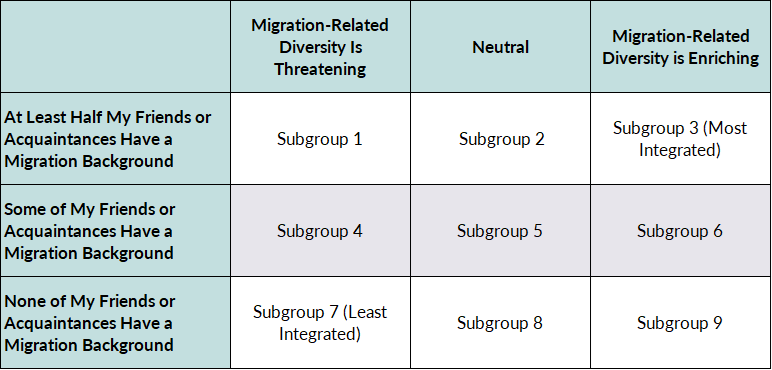
Drawing on results from the Becoming a Minority project, which collected data from several European cities, he provides a matrix to describe nine outcomes of individuals, each focused on different integration attitudes (see Figure 2). The most integrated individuals will exist in a diverse social network that believes immigration-related diversity is enriching, while the least integrated will be at the opposite end of the spectrum, feeling threatened by immigration and favoring a homogenous social circle.
Figure 2. Integration into Diversity Theory Matrix
Source: Maurice Crul, “Integration into Diversity Theory Renewing–Once Again–Assimilation Theory,” Journal of Ethnic and Migration Studies 50, no. 1 (2024): 257-71, available online.
The strength of this approach is that it does not take into consideration individual characteristics such as skin color or first language spoken. According to this theory, these factors do not really matter because there is no expectation of comparing individual characteristics to that of a mainstream population; neither the characteristics of the community nor the person matter. What matters instead is individual actions and attitudes towards diversity. The more tolerant a person is, the more integrated they are into their heterogenous society.
This approach is still rather new and, as such, does not yet explain which identity position a person will take. It is, in fact, only beginning to be used to predict characteristics such as feelings of belonging and perceptions of neighborhood security. Crul is clear in that he does not want his theory to replace new or segmented assimilation theory as an explanation of the integration process (he instead refers to it as an update), but the idea shifts the focus away from that of an individual melding into the mainstream. By positing the existence of nine subgroups, it becomes possible to envision multiple mainstreams with multiple attitudes towards integration. In a country such as Canada, this approach seems rather prescient.
Nonetheless, the utility of a new theoretical framework is best assessed empirically. Canada’s General Social Survey asks individuals how many of their friends are of the same immigrant group, although not about attitudes towards diversity. It would be interesting to add this question and find other ways to analyze integration into diversity theory.
Moving forward, immigration to Canada is only increasing. With extensive efforts to bring in more new arrivals every year, immigrants’ influence on the Canadian population is growing—and appears on course to continue doing so even as public disquiet has caused the government to seek to trim some immigration. Traditional notions of integration are becoming increasingly irrelevant in a country where nearly all population growth stems from immigration. New arrivals find their place in society not by assuming pre-existing norms, but by finding their people and their place and creating their own norms. In this way, Canada’s diversity will only continue to grow over time.
Sources
Alba, Richard. 2020. The Great Demographic Illusion: Majority, Minority, and the Expanding American Mainstream. Princeton, NJ: Princeton University Press.
Alba, Richard and Victor Nee. 2003. Remaking the American Mainstream. Cambridge, MA: Harvard University Press.
Åslund, Olof, Per-Anders Edin, Peter Fredriksson, and Hans Grönqvist. 2011. Peers, Neighborhoods, and Immigrant Student Achievement: Evidence from a Placement Policy. Applied Economics 3 (2): 67-95
Borjas, George J. 1998. To Ghetto or Not to Ghetto: Ethnicity and Residential Segregation. Journal of Urban Economics 44 (2): 228-53.
---. 2002. Homeownership in the Immigrant Population. Journal of Urban Economics 52 (3): 448-76.
Chartrand, Tyler and Leah F. Vosko. 2021. Canada's Temporary Foreign Worker and International Mobility Programs: Charting Change and Continuity among Source Countries. International Migration 59 (2): 89-109.
Crul, Maurice. 2024. Integration into Diversity Theory Renewing—Once Again—Assimilation Theory. Journal of Ethnic and Migration Studies 50 (1): 257-71. Available online.
Employment and Social Development Canada. 2024. Overhauling the Temporary Foreign Worker Program. Updated March 22, 2024. Available online.
Fong, Eric and Rima Wilkes. 1999. The Spatial Assimilation Model Reexamined: An Assessment by Canadian Data. International Migration Review 33 (3): 594-620.
Greenman, Emily and Yu Xie. 2008. Is Assimilation Theory Dead? The Effect of Assimilation on Adolescent Well-being. Social Science Research 37 (1): 109-37. Available online.
Immigration and Refugee Board of Canada (IRB). 2024. Act, Rules, and Regulations. Updated January 18, 2024. Available online.
Immigration, Refugees, and Citizenship Canada (IRCC). 2015. Temporary Residents: Overview. Updated August 1, 2015. Available online.
---. 2019. Family Class: The Application Process. Updated July 19, 2019. Available online.
---. 2020. Evaluation of Express Entry: Early Impacts on Economic Outcomes and System Management. Ottawa: IRCC. Available online.
---. 2023. 2023 Annual Report to Parliament of Immigration. Ottawa: IRCC. Available online.
---. 2023. Ministerial Instructions Respecting the Express Entry System. Updated May 11, 2023. Available online.
---. 2023. Notice–Supplementary Information for the 2024-2026 Immigration Levels Plan. Updated November 1, 2023. Available online.
---. 2023. Permanent Resident Program: Economic Classes. Updated June 16, 2023. Available online.
---. 2024. Humanitarian and Compassionate Considerations. Updated June 4, 2024 Available online.
---. 2024. Immigrant through Express Entry: Eligibility for Programs. Updated June 13, 2024. Available online.
---. 2024. Refugees and Asylum. Updated June 27, 2024. Available online.
Li, Yuchen and Michael Haan. 2023. From Temporary Foreign Workers to Permanent Residents: Differences in Transition Rates among Work Permit Categories. Canadian Ethnic Studies 55 (2): 127-60.
Logan, John R., Richard D. Alba, and Wenquan Zhang. 2002. Immigrant Enclaves and Ethnic Communities in New York and Los Angeles. American Sociological Review 67 (2): 299-322. Available online.
Massey, Douglas S. and Nancy A. Denton. 1985. Spatial Assimilation as a Socioeconomic Outcome. American Sociological Review 50: 94-106.
Massey, Douglas S. and Brendan P. Mullan. 1984. Processes of Hispanic and Black Spatial Assimilation. American Journal of Sociology 89: 836-74.
Myles, John and Feng Hou. 2004. Changing Colours: Neighbourhood Attainment and Residential Segregation Among Toronto's Visible Minorities. Canadian Journal of Sociology 29 (1): 29-58.
Portes, Alejandro and Rubén G. Rumbaut. 2001. Legacies: The Story of the Immigrant Second Generation. Los Angeles: University of California Press.
Portes, Alejandro and Min Zhou. 1993. The New Second Generation: Segmented Assimilation and Its Variants. The Annals of the American Academy of Political and Social Science 530 (1): 74-96.
Public Safety Canada. 2019. Refugee Reform. Updated July 16, 2019. Available online.
Seidle, F. Leslie. 2013. Canada's Provincial Nominee Immigration Programs: Securing Greater Policy Alignment. Montreal: Institute for Research on Public Policy (IRPP). Available online.
Statistics Canada. 2018. 150 Years of Immigration in Canada. Updated May 17, 2018. Available online.
---. 2022. Immigrants Make Up the Largest Share of the Population in Over 150 Years and Continue to Shape Who We Are as Canadians. October 26, 2022. Available online.
---. 2023. Canada’s Demographic Estimates for July 1, 2023: Record-High Population Growth Since 1957. September 27, 2023. Available online.
Tu, Jiong, 2010. The Effect of Enclave Residence on the Labour Force Activities of Immigrants in Canada. IZA Discussion Papers 4744, Institute of Labor Economics (IZA), Bonn, February 2010. Available online.
Vosko, Leah F. 2022. Temporary Labour Migration by Any Other Name: Differential inclusion under Canada’s ‘New’ International Mobility Regime. Journal of Ethnic and Migration Studies, 48 (1): 129-52.